
Email security & tested backups
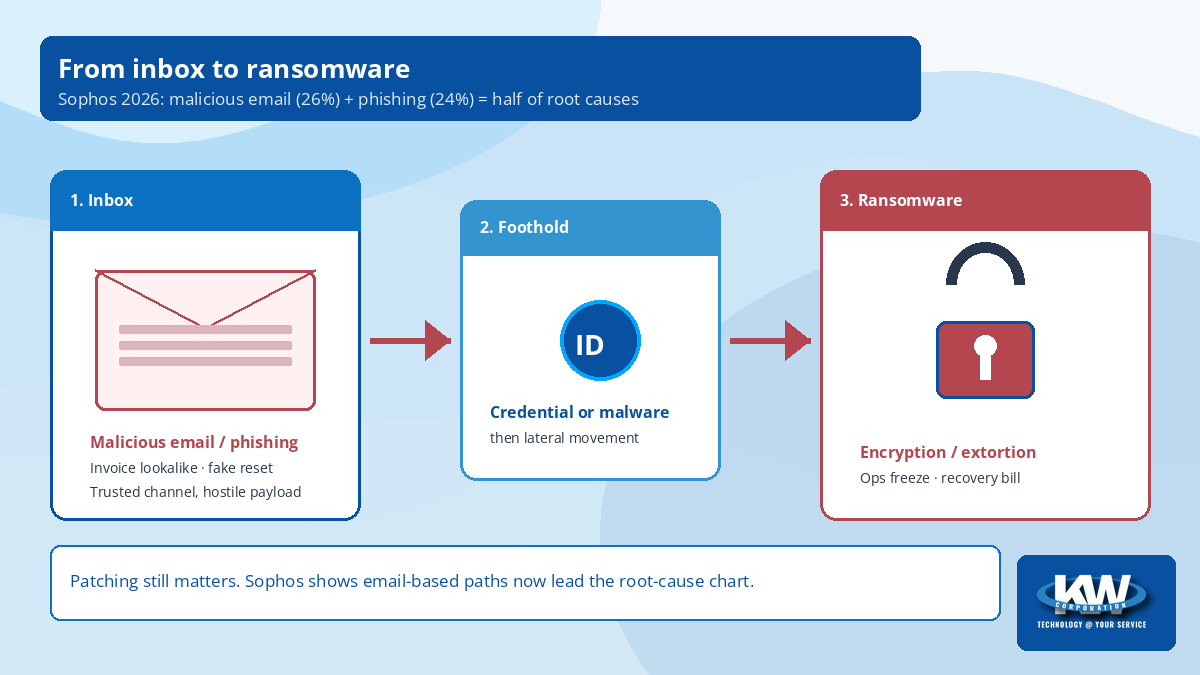
For years, "patch faster" was the headline after every ransomware report. That still matters. It is no longer the whole story. Sophos State of Ransomware 2026 found that malicious email (26%) and phishing (24%) were the top two technical root causes among organizations hit by ransomware - together half of all incidents in that survey. Exploited vulnerabilities fell to 18% and lost the number-one spot they held for three years.
For Mid-Michigan owners and IT leads, that shift is practical: the next ransomware conversation should start in the inbox - and end with backups you have actually restored.
Half of ransomware now starts in the inbox. Harden email. Train people. Test restores - not just backup jobs that say "success."
What Sophos reported
Sophos's seventh annual State of Ransomware survey asked IT and cybersecurity leaders in organizations that were hit by ransomware in the prior year how the attack started and what recovery cost. The technical root-cause ranking flipped: email-based paths (malicious email plus phishing) led; patching alone will not close the gap.
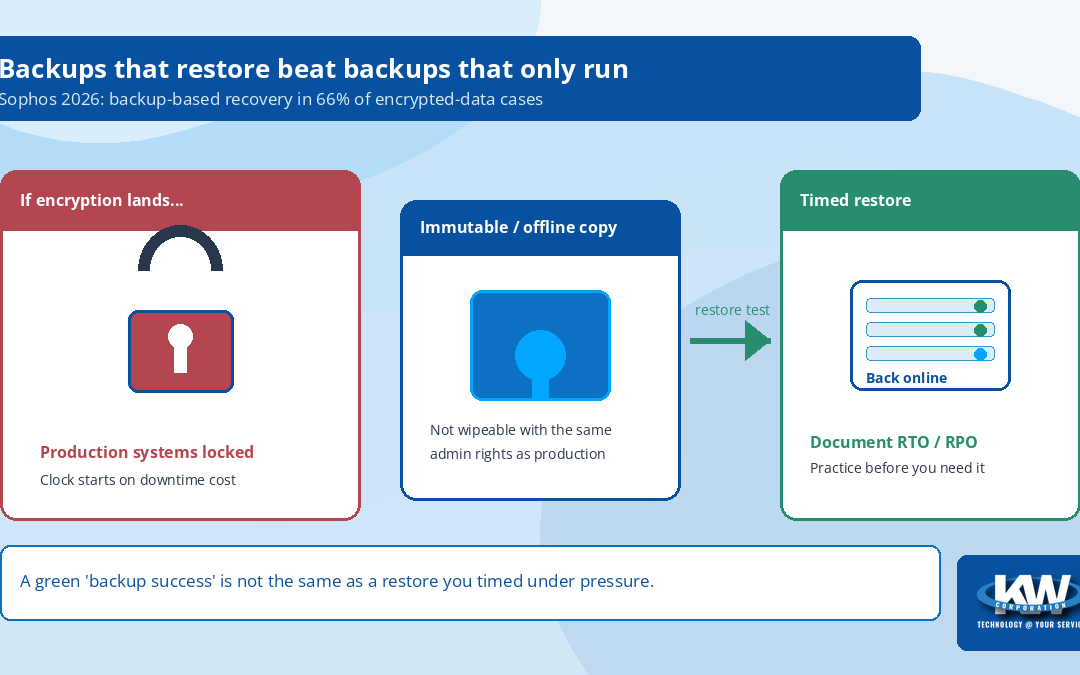
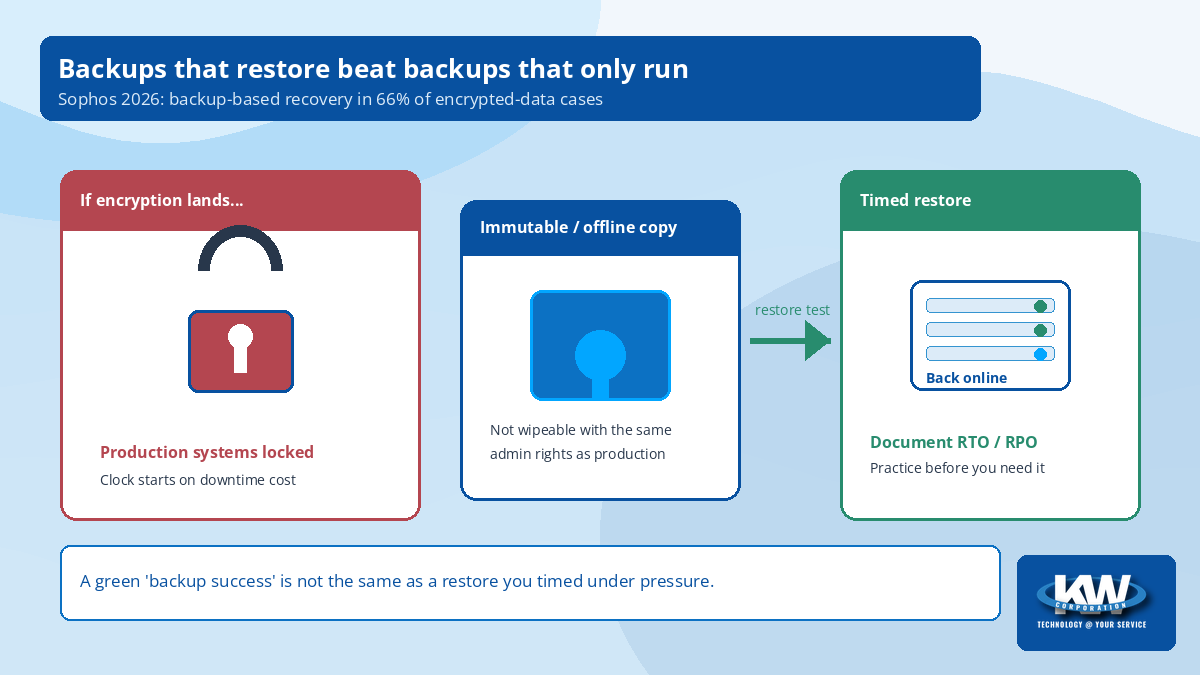
Sophos also reports a typical recovery bill of about $1.7 million - the average (mean) cost to recover was $1,700,200, excluding any ransom paid, and up about 11% from the prior year's report. Over half of attacks (56%) still succeeded in encrypting data. On the recovery side, backup-based recovery rose to 66% of encrypted-data cases - a reminder that recoverable backups change outcomes when prevention fails.
None of that is a Michigan-only census. It is a global survey of organizations that already got hit. Treat the percentages as a signal for where to invest attention: email filtering and authentication, user awareness, and tested backup and restore.
Michigan context: readiness is still low
MITechNews summarized a national Public Private Strategies Institute (PPSI) survey (Morning Consult) in an April 2026 Michigan cybercrime story. Among the readiness findings: only 30% of small businesses say they are prepared for ransomware.
That gap is not abstract for owners who already juggle thin IT time. Awareness without email controls and a restore drill leaves the same open door Sophos is measuring at the top of the root-cause list.
Closer to home: a Flint-area billing breach
HIPAA Journal reported that Mid Michigan Medical Billing Service, a Flint, Michigan revenue-cycle company serving healthcare clients, identified suspicious network activity on March 27, 2025. Investigation confirmed an unauthorized party accessed and copied data. The Qilin ransomware group claimed responsibility. File review found protected health information of 28,185 individuals exposed; the company worked with covered-entity clients on notice.
Public reporting does not confirm that email was the initial access path for that incident. Use it as a local illustration of impact - patient data, business-associate risk, Mid-Michigan operations - not as proof of a specific phishing click. The education point still stands: ransomware and data-theft events are not only coastal enterprise stories.
Why the inbox still wins for attackers
Email remains the business operating system for invoices, shipping changes, password resets, and "quick favors" from executives. Attackers forge that trust: malicious attachments, credential-harvest links, and business-email-compromise style payment redirects. Sophos separates malicious email and phishing in its root-cause chart; operators should treat both as inbox-class risk.
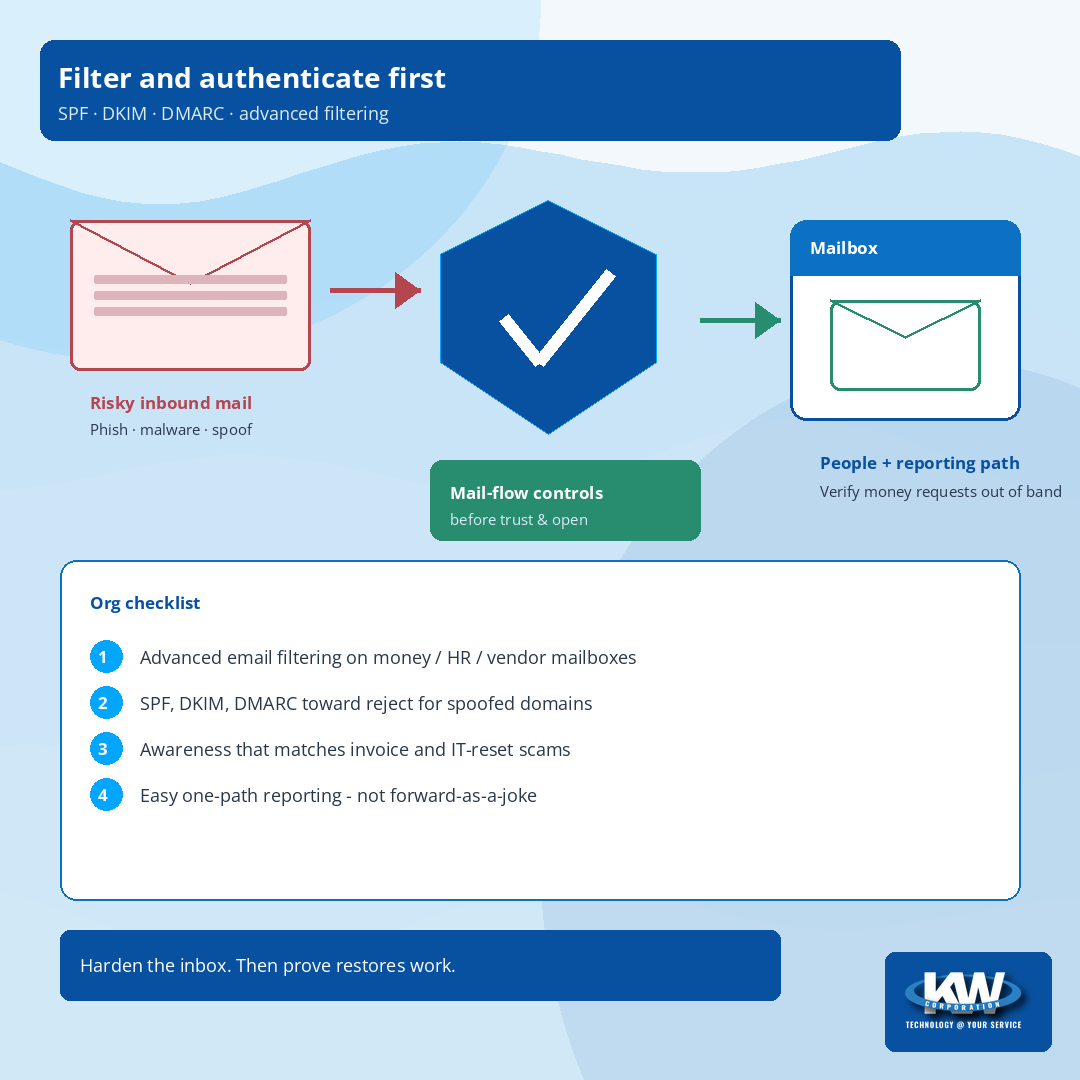
Defenses that match the data: advanced filtering, spoofing controls (SPF, DKIM, DMARC), phishing-resistant habits for high-risk roles, and clear reporting paths when something feels off. None of that replaces patching - it fills the half of the chart that patching never owned.
What to do
For every employee
- Pause on urgent money, password, or "wire now" requests - verify out of band
- Report suspicious mail with one click or one helpdesk path; do not forward to coworkers as a joke
- Treat unexpected attachments and login pages as hostile until proven otherwise
- Use MFA everywhere it is offered; still tell IT if a prompt feels wrong
For organizations
- Deploy and tune advanced email security; enforce SPF, DKIM, and DMARC
- Run phishing awareness that matches real invoice and vendor-change scams
- Keep immutable or offline backup copies attackers cannot wipe with the same admin rights
- Schedule restore tests; document RTO/RPO and who owns the drill
- Put email and backup health on the same ransomware table as patching
Practical checklist
Confirm advanced email filtering is on for every mailbox that handles money, HR, or vendor changes.
Publish SPF, DKIM, and a DMARC policy that moves toward rejection of spoofed domains - monitor reports before you lock it.
Train staff on invoice fraud and fake "IT reset" mail; measure report rates, not only click rates.
Keep at least one backup copy offline or immutable so ransomware on the domain cannot delete every copy.
Run a restore test on a critical system this quarter and write down how long it really took.
Put email security health and backup restore results on the same leadership review as patching.
Bottom line for Mid-Michigan teams
Sophos reports that half of ransomware root causes in its 2026 survey of hit organizations started with malicious email or phishing. PPSI survey findings covered by MITechNews show only 30% of small businesses say they are prepared for ransomware. A Flint-area billing breach affecting 28,185 people shows the local stakes when data is stolen - without needing to invent how that attacker got in.
KW Corporation is part of your team. Our Managed IT practice helps Mid-Michigan and statewide clients harden email security, raise phishing readiness, and design backup programs that include scheduled restore tests - so the inbox is not the softest door on the building.
Ready to harden email and test restores?
KW's Managed IT team can help Mid-Michigan organizations review mailbox security, spoofing controls, and backup restore drills before ransomware makes the timeline for you.
Educational commentary only. See original pages for full survey methods and guidance:
Sophos - State of Ransomware 2026 - Report PDF - MITechNews - PPSI readiness (Apr 2026) - HIPAA Journal - Mid Michigan Medical Billing / Qilin
Technology @ Your Service
KW Corporation - 307 W. Grand River Ave, Fowlerville, MI 48836 - 517-223-3610 - support@kw-corp.com